Description du produit
OEM custom convceyor systerm plastic moulding injection pom delrin conveyor chain
Advantages:
1.A complete range of specification
2.free design offer OEM & ODM
3.free sample available
4.professional service team
5.specialize CNC machining and injection over 10 years
6.Custom accept as per drawing or sample
POM (Polyformaldehyde)
POM (Full-name: Polyformaldehyde), is a engineering plastics of non-side-chain, high density, high crystalline and linear polymer, which is praised “Plastic Steel”, and has comprehensive excellent performances, such as: wear-resistance, high hardness, anti-impregnant, good rigidity (Tensile modulus of elasticity), chemical stability, isolation resistance and dimensional stability. POM has widely applied in Automobile industries, electronic and electric products, commodity, pipeline & fittings, exact apparatus and so on, which can be instead of the bronze, Zinc, tin and other metals.
Except POM-H, is often copolymerized with ethylene oxide together, in order to avoid the melting of POM material in the high temperature. POM-H has the better performances than POM-C in its high crystalline, mechanical strength and rigidity. And POM-C has the better performances than POM-H in its low melting point, temperature stability, fluxion characteristic and machining capability.
Father more, POM-H+PTFE, which is made from the Delrin POM Resin that maxed Teflon fiber symmetrically, has the low co-efficient of frication, good lubrication, wear-resistance, non-creepage resistance.
Automobile industries: POM has a large application in car industries, because the mechanical parts made by POM, which has the advantages of high mechanical strength, high hardness, good wear-resistance, low co-efficient of friction, easy to maintain, reducing cost and so on, can be used in cars instead of coppery half stalk and planet gear. It not only saving copper materials, but also improving service life. At the engine fuel system, components for hose valves and case cover of radiator, cooling fluid’s standby case, water valve, oil box’ cover, pump impeller, shell of gasification machine and accelerator pedal and so on.
Electronic and electric Industries: because of its lower power consuming, high dielectric strength and insulation resistance and electronic arc resistance, POM has widely applied in electronic and electric Industries, such as: shell of electronic spanner, shell of electronic scissors, shell of coal drilling machine ,handle of switch, parts also for phone, wireless recorder, video tape recorder, television, computer, electrograph, calculagraph, bracket of recorder tape and so on.
Agricultural machine: part of manual sprayer, joint and transport part of seeder, parts of milk machine, shell of irrigation and drainage, valve, joint and bush of water and so on.
Other field:
Pharmacy & packing Machine: transporting screw, planet gear, gear bar, chain wheel and cushion bar and so on.
Construction industries: water tap, window frame, wash pot, water tank, pulley for portiere, shell of water meter and tie-in of water pipe.
Color:White,Black,Natural,Rice Yellow brown and so on.
Taille:1000X2000X(Thickness:1-200mm),1220X2440X(Thickness:1-200mm)
600X1200X(Thickness:1-200mm)
| Modèle | inejction POM conveyor chain |
| Matériel | POM / Nylon/ PVC or customized |
| Diameter | 1-250mm or customized |
| Length | 500mm,1000mmor customized |
| Color | Natural,White,Black,ect. |
| OEM & ODM | Yes |
| Certification | ISO9001,SGS,FDA,RoHS,Test Report,ect. |
| Free Sample | Yes |
| Density | 1.6g/ cm2 |
| Shape | sheet, rod, tube, gear, pulley, guide rail……or according to your demand |
| Emballage | Plastic bags,Cartons,Wodden case,Pallet,Container,ect. |
| Avantage | One stop procurement |
Product Photo
| Matériel: | Plastic |
|---|---|
| Structure: | Chaîne de feuilles |
| Traitement de surface : | Polissage |
| Taille de la chaîne : | 1/2"*3/32" |
| Fonctionnalité: | Fire Resistant, Heat Resistant |
| Certificate: | ISO9001: 2008, Test Report |
| Personnalisation : | Disponible | Demande personnalisée |
|---|

Quels sont les critères à prendre en compte pour choisir une chaîne de convoyeur résistante à la corrosion ?
Lors du choix d'une chaîne de convoyeur résistante à la corrosion, plusieurs facteurs doivent être pris en compte afin de garantir des performances optimales et une longue durée de vie en milieu corrosif. Voici les principaux éléments à considérer :
– Sélection des matériaux :
Choisissez un matériau pour la chaîne de convoyeur résistant aux agents corrosifs spécifiques présents dans l'environnement. L'acier inoxydable, le plastique et les revêtements spéciaux tels que le zingage ou le nickelage sont couramment utilisés pour leurs propriétés de résistance à la corrosion.
– Indices de résistance à la corrosion :
Examinez les indices de résistance à la corrosion des différents matériaux et revêtements de chaînes. Recherchez les normes industrielles telles que les normes ASTM ou ISO qui indiquent la résistance du matériau à des substances corrosives ou à des conditions environnementales spécifiques.
– Facteurs environnementaux :
Tenez compte des facteurs environnementaux spécifiques qui contribuent à la corrosion, tels que l'humidité, la température, la présence de produits chimiques ou de solvants, et l'exposition à l'eau salée ou aux acides. Évaluez comment ces facteurs peuvent affecter les exigences de résistance à la corrosion de la chaîne.
– Revêtement ou traitement de surface :
Si vous utilisez une chaîne métallique, envisagez d'appliquer des revêtements ou des traitements de surface supplémentaires pour améliorer sa résistance à la corrosion. Vous pouvez opter pour la galvanoplastie, le revêtement en poudre ou l'utilisation de revêtements anticorrosion spécifiques.
– Compatibilité avec les méthodes de nettoyage :
Assurez-vous que le matériau de la chaîne choisi est compatible avec les méthodes de nettoyage et les produits chimiques utilisés. Certains matériaux résistants à la corrosion peuvent nécessiter des procédures de nettoyage spécifiques pour préserver leurs performances et leur durée de vie.
– Considérations opérationnelles :
Tenez compte de la capacité de charge, de la vitesse et des exigences opérationnelles du système de convoyage. Assurez-vous que la chaîne résistante à la corrosion puisse supporter les contraintes mécaniques et les exigences opérationnelles sans que ses propriétés de résistance à la corrosion ne soient altérées.
– Rapport coût-efficacité :
Il convient d'évaluer le coût initial et les avantages à long terme de l'utilisation d'une chaîne de convoyeur résistante à la corrosion. Bien que les matériaux résistants à la corrosion puissent présenter un coût initial plus élevé, ils permettent de réduire considérablement les coûts de maintenance, de remplacement et d'arrêt de production liés aux pannes dues à la corrosion.
En tenant compte de ces facteurs, vous pouvez sélectionner une chaîne de convoyeur résistante à la corrosion, parfaitement adaptée à l'environnement corrosif spécifique, garantissant des performances fiables et durables dans des applications telles que le traitement chimique, la production alimentaire, le traitement des eaux usées ou les environnements extérieurs.
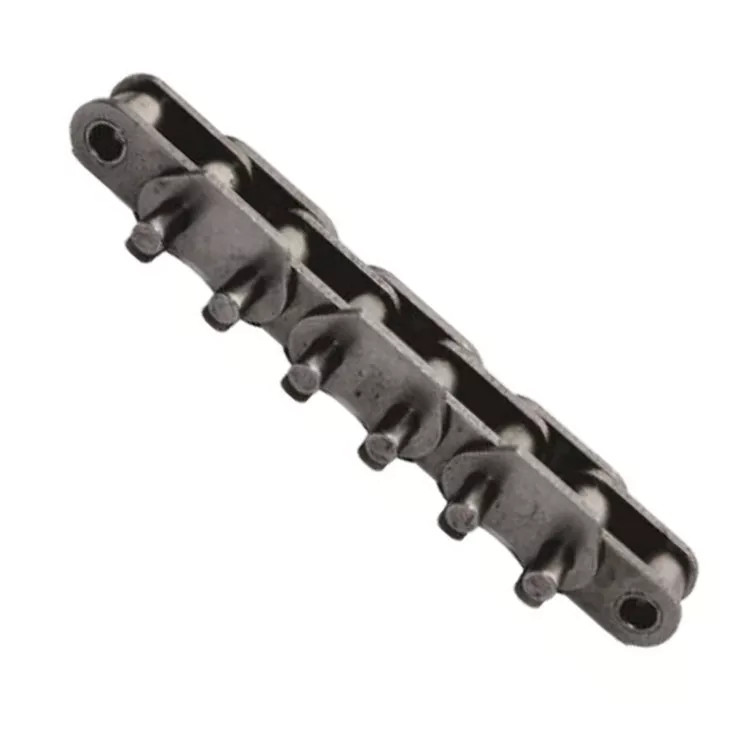
How does a conveyor chain handle different types of materials?
A conveyor chain is designed to handle a wide variety of materials in diverse industrial applications. It is capable of efficiently transporting different types of materials, including:
1. Bulk Materials: Conveyor chains are commonly used to handle bulk materials such as grains, coal, ores, aggregates, and powders. The design of the chain, including the spacing and shape of the links, helps prevent material spillage and ensures smooth and consistent flow.
2. Packaged Goods: Conveyor chains are also used for conveying packaged goods such as boxes, cartons, crates, and pallets. They provide a stable and reliable method of transporting these items along the production line, reducing manual handling and increasing productivity.
3. Small Parts: Conveyor chains with specialized attachments or small-pitch configurations are suitable for handling small parts or components. These chains ensure precise positioning and gentle transport of delicate or intricate items.
4. Heavy-Duty Loads: Industrial conveyor chains are capable of handling heavy-duty loads, such as automotive parts, machinery components, and large equipment. They are engineered to withstand the weight and stress of these objects, providing reliable and efficient material handling in demanding environments.
5. Food and Beverage Products: Conveyor chains used in the food and beverage industry are designed to meet strict hygiene and safety standards. They are constructed from materials that are resistant to corrosion, easy to clean, and compliant with food-grade regulations. These chains ensure the safe and contamination-free handling of food products.
6. Hazardous Materials: Conveyor chains can be used to safely transport hazardous materials, such as chemicals or waste products. Specialized chains with additional safety features, such as sealed housings or containment systems, are utilized to minimize the risk of spills or leaks.
Conveyor chains can be customized with different chain configurations, attachments, and accessories to accommodate specific material characteristics and handling requirements. The selection of the appropriate chain type, material, and design parameters ensures optimal performance and efficient material handling for a wide range of materials.

What are the different types of conveyor chains?
There are several types of conveyor chains available, each designed to meet specific application requirements. Here are some common types of conveyor chains:
- Roller chains: Roller chains are the most commonly used type of conveyor chain. They consist of a series of cylindrical rollers connected by side plates. Roller chains provide smooth and efficient movement and are suitable for medium to heavy-duty applications.
- Double pitch chains: Double pitch chains have larger pitch (distance between the centers of adjacent pins) compared to standard roller chains. They are often used in applications that require slower speeds and lighter loads.
- Hollow pin chains: Hollow pin chains have hollow pins that allow for easy attachment of various accessories or attachments. They are commonly used in conveying applications that require customization or where attachments need to be mounted.
- Apron or slat chains: Apron or slat chains consist of plates or slats that are connected by hinges. They are used in heavy-duty applications where the chain needs to support and carry large loads or withstand harsh environments.
- Plastic chains: Plastic chains are made of durable and lightweight materials such as acetal or polyethylene. They offer benefits such as corrosion resistance, low noise levels, and the ability to work in wet or washdown environments. Plastic chains are commonly used in food processing, packaging, and pharmaceutical industries.
These are just a few examples of conveyor chain types, and there are many other variations available depending on specific application requirements. The selection of the appropriate conveyor chain type depends on factors such as load capacity, speed, environment, and desired functionality.


editor by CX 2023-07-20