Core Operational Mechanics
The efficiency of a scraper chain stems from the interaction between chain speed, scraper spacing, and material properties. Upon startup, the drive unit rotates the sprocket, thus propelling the chain. Scrapers embedded in the material bed generate thrust, which is transmitted through friction between the materials. This holistic effect—the material moving as a whole—distinguishes scraper chains from drag conveyors with exposed scrapers. Resistance primarily arises from wall friction and the interaction between the scrapers and the material, rather than belt tension, resulting in lower energy consumption compared to screw conveyors, typically saving nearly 50% of energy in similar applications.
The chain’s structural materials include wear-resistant manganese alloy steel, fatigue-resistant carburized and hardened components, and a specialized coating to prevent corrosion in damp ash or chemical environments. Pitch sizes range from 100 mm to over 300 mm and can be customized to meet throughput requirements; larger pitches reduce weight while maintaining strength but require careful scraper placement to prevent material fallback.
Distinctions from Adjacent Technologies
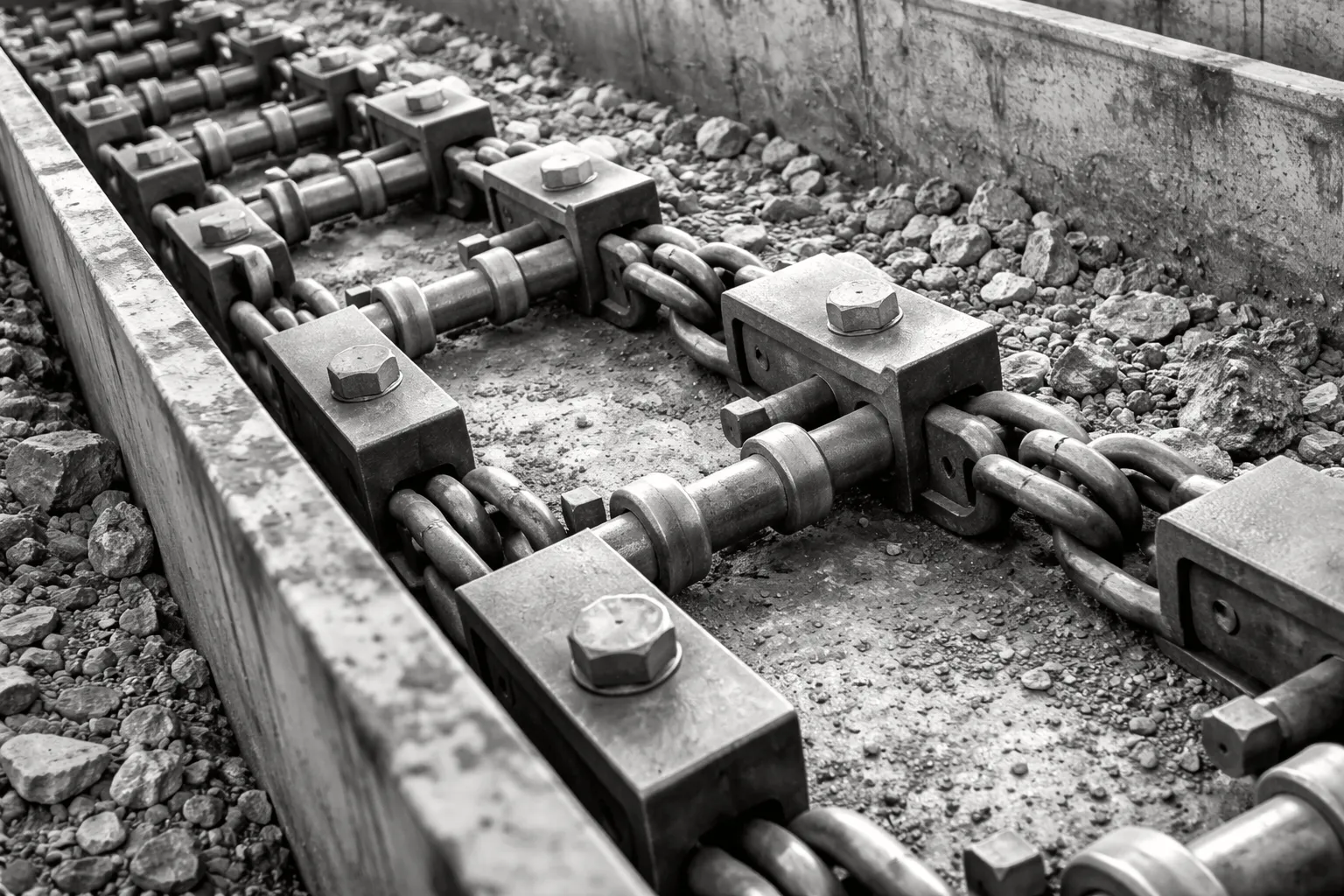
Scraper chains differ significantly from skirted conveyors, which use overlapping plates to transport unit loads or employ pneumatic systems relying on air suspension. Unlike bucket conveyors with protruding blades that allow for open material cleaning, scraper chains are deeply embedded within the conveyor, providing a dust-proof enclosure. The integral design further utilizes lateral pressure effects, enabling vertical lifting without auxiliary mechanisms. These characteristics make scraper chains indispensable in applications where environmental control or material integrity protection is critical.
Scraper chains are used across numerous industries. In mining, they transport coal or ore from the working face to ground storage silos. Cement plants rely on them to transport clinker after the kiln. Power plants use submerged scraper chains for bottom ash removal, combining water cooling with conveying. Sugar mills use them to handle bagasse, while chemical plants use them to process phosphates or fertilizers. Each application leverages the scraper chain’s resistance to high temperatures (up to 900°C in ash pipelines) or abrasive media that could damage other types of systems.
Structural Components in Depth
The trough is typically constructed from wear-resistant steel plates (such as RAEX 450 or equivalent) to form the container. The bottom lining is usually made of cast stone or chromium carbide to reduce wear from continuous contact with the scraper. The drive assembly uses a geared motor with a torque-limiting coupling to prevent overload due to material blockage. Tensioning employs a spring or hydraulic tensioning mechanism to ensure stable chain sag control over spans exceeding 100 meters.
The scraper geometry is tailored to the application. Forged scrapers enhance the scraping ability against viscous sludge. Bolted connections allow for quick replacement without chain disassembly. In high-wear conditions, polyurethane or ceramic inserts extend maintenance intervals. Where feasible, automated chain lubrication systems are used to reduce wear during idling.
Performance Metrics and Optimization
Throughput is closely related to chain speed (typically 0.2–0.8 m/s), cross-sectional fill rate (up to 90% in bulk mode), and bulk density. Well-designed scraper chains can handle hundreds to thousands of tons of material per hour over working distances of hundreds of meters. Low rolling or sliding friction is key to improved energy efficiency; recent innovations have introduced rolling elements at the scraper-to-chub interface, reducing scraping resistance by nearly 90% in specific tests.
Maintenance primarily revolves around periodic checks of chain link elongation, scraper wear, and sprocket tooth profile. Predictive monitoring through vibration analysis can detect early failures. Modular chutes facilitate segmented replacement, minimizing downtime during continuous operation.
Scraper chains embody engineering pragmatism: simple in concept, powerful in function. They can handle a wide variety of harsh materials in confined environments, ensuring operational continuity even when other alternatives fail. As industries strive for higher output and lower environmental footprints, these supply chains remain vital, silently driving the flow of materials across global production.
Case Study 1: Coal Mining Face Evacuation Retrofit
During the mining of bituminous coal seams in a medium-sized underground coal mine, the existing scraper conveyor frequently experienced chain breakage and excessive material spillage under a peak load of 1500 tons/hour. Data before installation showed that due to chain elongation exceeding 3%, the average downtime was 18 hours per month; the average power consumption for 200 meters of operation was 220 kW; and the material backflow rate was as high as 8-12%, leading to increased cleaning labor costs.
After deploying an optimized scraper chain system, performance was significantly improved. This system uses forged chain links, uneven scraper spacing (alternating between 6-tooth and 8-tooth configurations), and an optimized scraper topology. At the same length, chain mass was reduced by 26.2%, and no-load energy consumption was reduced by 15-20%. The conveying capacity stabilized at 1800-2200 tons/hour, with no backflow. Downtime plummeted to less than 4 hours per month, mainly for routine inspections. Average power demand dropped to 165 kW, thanks to the reduced friction of the roller-type scrapers. Material leakage has been reduced to almost zero, requiring no external cleanup.
Quantitative Pre- vs Post-Comparison
Before: Monthly energy expenditure 158,400 kWh; failure incidents 7 per quarter; scraper wear replacement every 4 months. After: Energy use 118,800 kWh monthly; failures 1 per quarter; scraper life extended to 9 months. ROI realized within 14 months through reduced power, labor, and lost production.
Case Study 2: Cement Clinker Cooling Line Upgrade
A large rotary kiln facility grappled with clinker transport inefficiencies post-cooler. Traditional pan conveyors exhibited frequent jamming from hot (350-450°C) agglomerates, with pre-installation metrics showing 1200 t/h nominal capacity derated to 900 t/h effective, energy at 180 kW, and chain replacement every 6-8 months due to thermal fatigue.
Implementation of a high-temperature scraper chain with heat-resistant alloy links and cast stone-lined trough yielded marked gains. Capacity rose to consistent 1400 t/h. Energy consumption fell to 135 kW, aided by lower internal resistance. Chain longevity doubled to 14-16 months. Dust emissions decreased 70% owing to full enclosure, aiding compliance with particulate limits.
Pre- and Post-Installation Metrics
Prior: Annual downtime 320 hours; maintenance spend $420,000; throughput variability ±25%. Subsequent: Downtime 110 hours; maintenance $180,000; variability ±8%. Enhanced thermal stability prevented clinker adhesion issues prevalent in prior setup.
Case Study 3: Power Station Bottom Ash Handling Conversion
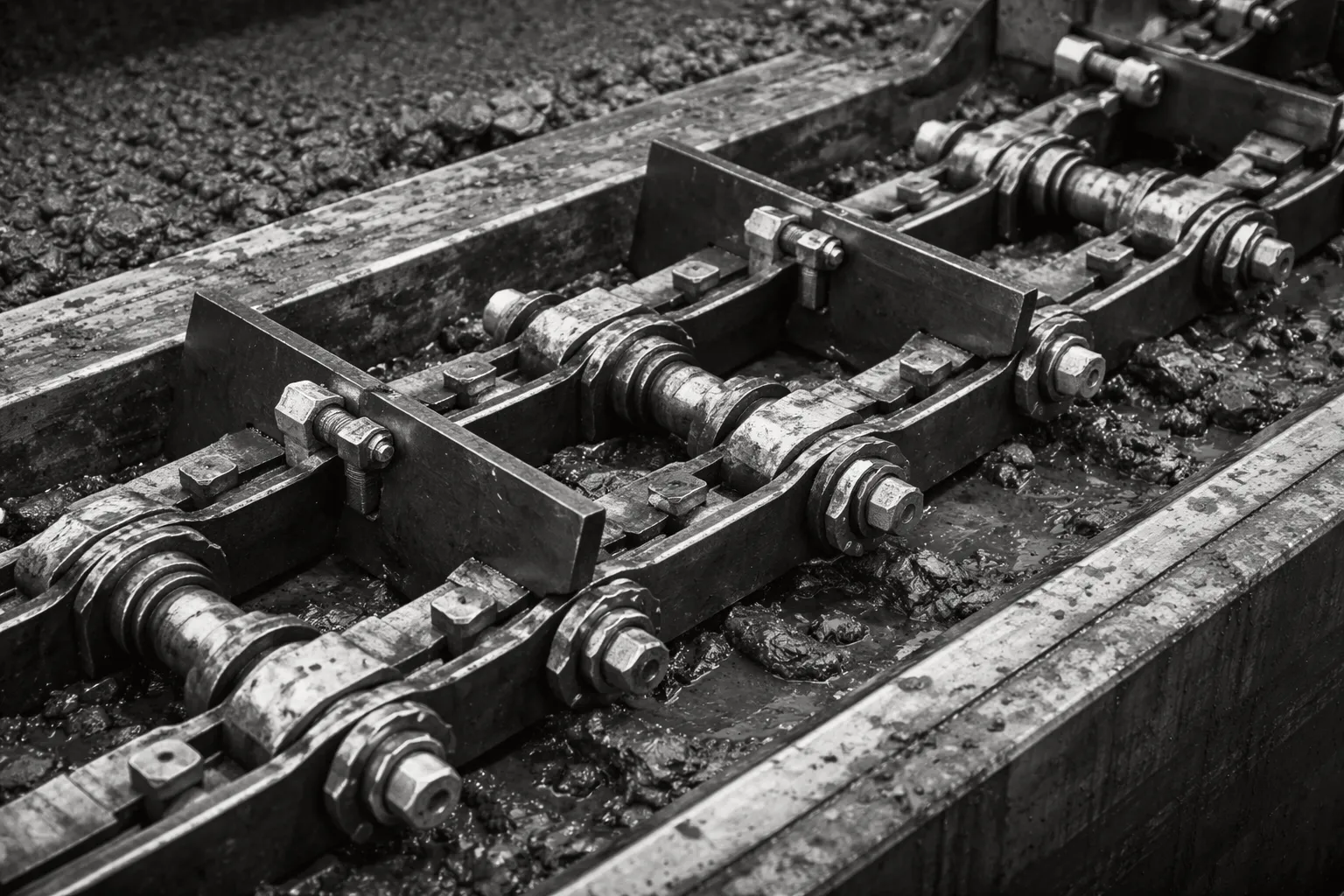
At a coal-fired plant, submerged scraper conveyors for bottom ash removal operated with conventional chains prone to corrosion and elongation in wet, alkaline quench water. Baseline data indicated 800 t/day ash throughput, 95 kW power draw per unit, chain stretch requiring monthly adjustments, and replacement cycles of 12 months.
Transition to corrosion-resistant, high-strength kazıyıcı zincirleri with sealed bushings and winged scrapers transformed reliability. Throughput increased to 1100 t/day without overflow. Power reduced to 72 kW per conveyor. Adjustment intervals extended to quarterly. Service life reached 28 months. Reduced wear minimized slag buildup, ensuring continuous discharge.
Performance Contrast
Pre-upgrade: Annual failures 9; energy 69,000 kWh/unit; corrosion pitting depth 1.2 mm/year. Post-upgrade: Failures 2; energy 52,000 kWh; pitting negligible. Environmental benefits included lower effluent particulates from stable operation.
Case Study 4: Sugar Mill Bagasse Dewatering and Transport
In a tropical sugar refinery, bagasse conveyance from presses to boilers relied on open drag chains suffering high moisture carryover and frequent blockages. Pre-data: 600 t/day capacity, 140 kW consumption, 22% moisture retention causing boiler inefficiencies, monthly cleanouts.
Adoption of enclosed kazıyıcı zincir with perforated trough sections for drainage and robust flight design elevated performance. Capacity climbed to 850 t/day. Power dropped to 105 kW. Moisture reduced to 14%, improving combustion efficiency by 8%. Blockages virtually eliminated, cleanouts quarterly.
Before-After Data Summary
Initial: Boiler efficiency 68%; downtime 15 hours/month; fuel variability high. Revised: Efficiency 76%; downtime 3 hours/month; consistent calorific value. Cost savings from reduced auxiliary fuel and maintenance exceeded projections.
gzl tarafından düzenlendi