Produktbeskrivelse
Produktbeskrivelse
Product Parameter
| Product Name | Cathode Copper Conveyor Chain |
| Standard | GB, ISO, ANSI, DIN |
| Structure | Conveyor chain |
| Treatment | Heat treatment |
| Certificeringer | ISO9001:2015, GB/T19001-2016, ISO1400:2015 |
| Trækstyrke | High strength |
| Emballage | Plastic Bag+ Carton+Wooden Case |
| Anvendelse | Industry Machinery |
More Products
Fordel
Certificeringer
DETAILS ABOUT CZPT CHAIN
Exhibition
Workshop
Packaging Details
Shipping
Ofte stillede spørgsmål
1. Are you a manufacturer or trade Company?
We are a factory founded in 1997 with a trade team for international service.
2. What terms of payment do you usually use?
T/T 30% depositum og 70% mod dokument, Western Union, L/C ved syne
3. Hvad er din leveringstid for dine varer?
Normally 35 days after confirmed order. 30 days could be available in the low season for some items (during May to July), and 45 days during the new year and hot season ( Jan to March).
4. Samples
For customers who need sample confirmation before ordering, please bear in mind that the following policy will be adopted:
1) All samples are free of charge with a maximum value not exceeding USD 100.
2) The courier cost for the first-time sample sending will be charged by the consignee. We will send the samples with freight to be collected. So please inform your account with FedEx, UPS, DHL, or TNT so that we can proceed promptly.
3) The first-time courier cost will be deducted from the contract value of the trial cooperation.
| Materiale: | Stainless Steel |
|---|---|
| Struktur: | Rullekæde |
| Overfladebehandling: | Polering |
| Kædestørrelse: | 1/2"*11/128" |
| Funktion: | Fire Resistant, Oil Resistant, Heat Resistant |
| Heat Treatment: | High Temperature Hardening |
| Prøver: | US$ 0/Piece 1 stk. (min. ordre) | |
|---|
| Tilpasning: | Tilgængelig | Tilpasset anmodning |
|---|

What are the considerations for selecting a corrosion-resistant conveyor chain?
When selecting a corrosion-resistant conveyor chain, several considerations should be taken into account to ensure optimal performance and longevity in corrosive environments. Here are the key factors to consider:
– Material Selection:
Choose a conveyor chain material that is resistant to the specific corrosive agents present in the environment. Stainless steel, plastic, and special coatings such as zinc or nickel plating are commonly used for their corrosion resistance properties.
– Corrosion Resistance Ratings:
Review the corrosion resistance ratings of different chain materials and coatings. Look for industry standards such as ASTM or ISO ratings that indicate the material’s resistance to specific corrosive substances or environmental conditions.
– Environmental Factors:
Consider the specific environmental factors that contribute to corrosion, such as humidity, temperature, presence of chemicals or solvents, and exposure to saltwater or acids. Evaluate how these factors may impact the chain’s corrosion resistance requirements.
– Coating or Surface Treatment:
If using a metal chain, consider applying additional coatings or surface treatments to enhance its corrosion resistance. Options may include electroplating, powder coating, or using specialized anti-corrosion coatings.
– Compatibility with Cleaning Methods:
Ensure that the selected chain material is compatible with the cleaning methods and chemicals used in the application. Some corrosive-resistant materials may require specific cleaning procedures to maintain their performance and longevity.
– Operational Considerations:
Take into account the load capacity, speed, and operational requirements of the conveyor system. Ensure that the corrosion-resistant chain can withstand the mechanical stresses and operational demands without compromising its corrosion resistance properties.
– Cost-Effectiveness:
Weigh the initial cost and long-term benefits of using a corrosion-resistant conveyor chain. While corrosion-resistant materials may have a higher upfront cost, they can significantly reduce maintenance, replacement, and downtime costs associated with corrosion-related failures.
By considering these factors, you can select a corrosion-resistant conveyor chain that is well-suited for the specific corrosive environment, ensuring reliable and durable performance in applications such as chemical processing, food production, wastewater treatment, or outdoor environments.
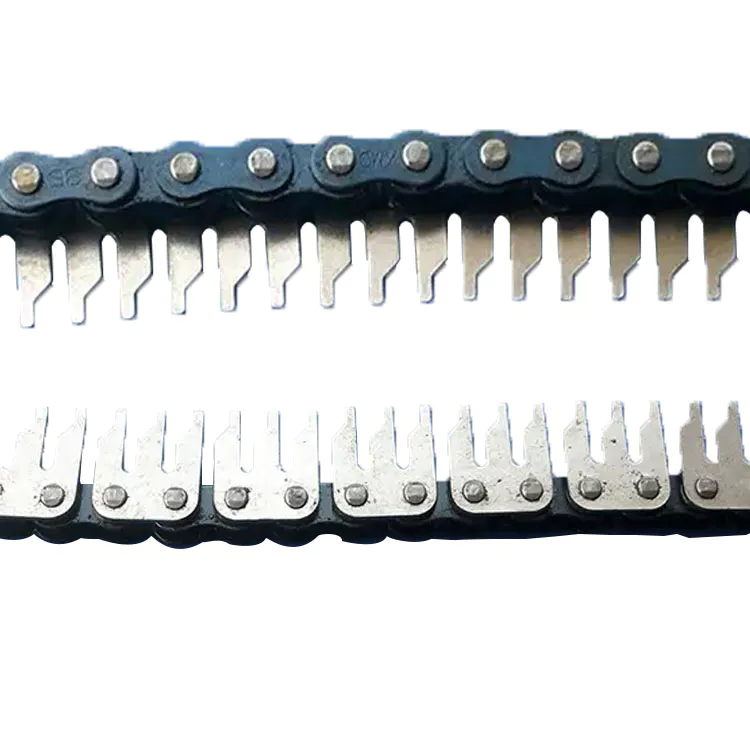
Can a conveyor chain be used in food processing applications?
Yes, a conveyor chain can be used in food processing applications. Conveyor chains play a crucial role in the efficient and hygienic handling of food products throughout the production process. Here are some key points to consider:
1. Food-Grade Materials: Conveyor chains used in food processing applications are typically made from food-grade materials such as stainless steel or plastic. These materials are corrosion-resistant, easy to clean, and comply with food safety regulations.
2. Hygiene Considerations: Food processing environments require high standards of hygiene. Conveyor chains designed for food applications incorporate features such as smooth surfaces, open link designs, and easy disassembly for thorough cleaning. They may also have specialized coatings or treatments to prevent bacterial growth.
3. Sanitary Design: Conveyor chains for food processing applications are designed with minimal crevices or joints to prevent food particles from getting trapped. They may have self-draining capabilities to remove excess fluids or debris.
4. Product Integrity: Conveyor chains in food processing applications ensure gentle handling of delicate food products to avoid damage or contamination. They can be equipped with accessories like cleats, side guards, or modular belt systems to securely hold and transport items of various shapes and sizes.
5. High Temperature and Washdown Capabilities: Some food processing applications require conveyor chains to withstand high temperatures during cooking, baking, or sterilization processes. Specialized chains with heat-resistant materials or coatings are available. Additionally, conveyor chains used in food processing should be capable of withstanding frequent washdowns and cleaning with water or cleaning agents.
6. Compliance with Standards: Conveyor chains used in food processing applications must comply with industry-specific standards such as FDA (Food and Drug Administration) regulations, HACCP (Hazard Analysis Critical Control Point) guidelines, and other food safety certifications.
When selecting a conveyor chain for food processing applications, it is important to consider the specific requirements of the production line, including the type of food being handled, the operating conditions, and the necessary sanitary standards. Proper maintenance and regular cleaning protocols should also be implemented to ensure food safety and product integrity.
Hvilke sikkerhedsforanstaltninger skal følges, når man arbejder med transportkæder?
Arbejde med transportkæder indebærer potentielle farer, og det er vigtigt at følge de nødvendige sikkerhedsforanstaltninger for at sikre medarbejdernes velbefindende og forhindre ulykker. Her er nogle vigtige sikkerhedsforanstaltninger, du skal overveje:
- Korrekt træning: Sørg for, at medarbejdere, der betjener eller vedligeholder transportkæder, modtager korrekt træning i sikker praksis, herunder håndtering af kæder, vedligeholdelsesprocedurer og nødprotokoller.
- Personligt beskyttelsesudstyr (PPE): Arbejdstagere bør bære passende personlige værnemidler, såsom sikkerhedsbriller, handsker og sko med ståltå, for at beskytte sig mod potentielle farer, herunder flyvende genstande, klemmepunkter eller sammenfiltring.
- Lockout/Tagout: Før der udføres vedligeholdelses- eller reparationsopgaver på transportkæder, skal du følge procedurerne for låsning/mærkning for at isolere og afbryde strømmen til udstyret og forhindre utilsigtet opstart eller frigivelse af lagret energi.
- Bevogtning: Sørg for, at transportbåndskæderne er tilstrækkeligt afskærmet for at forhindre adgang til bevægelige dele, såsom klempunkter og roterende tandhjul. Afskærmningerne skal være sikkert på plads og ikke forstyrre kædens drift.
- Rengøring: Hold arbejdsområdet rent og fri for snavs, værktøj eller andre genstande, der kan forårsage snublefare eller forstyrre transportbåndskædens drift.
- Regelmæssige inspektioner: Inspicer regelmæssigt transportbåndskæderne for tegn på slid, skader eller forkert justering. Håndter eventuelle problemer omgående for at forhindre potentielle sikkerhedsfarer.
- Sikker lastning og losning: Når du læsser eller losser materialer på transportbåndet, skal du følge sikre løfteteknikker og sørge for, at lasten er jævnt fordelt for at forhindre overbelastning eller ubalance.
- Nødstopanordninger: Installer og marker tydeligt nødstopanordninger langs transportbåndssystemet for at muliggøre øjeblikkelig nedlukning i tilfælde af en nødsituation eller farlig situation.
- Klar kommunikation: Etabler klare kommunikationsprotokoller, herunder signaler eller skilte, for at sikre effektiv kommunikation mellem medarbejdere, der betjener forskellige sektioner af transportbåndssystemet.
Disse sikkerhedsforanstaltninger er generelle retningslinjer, og det er vigtigt at konsultere og overholde specifikke sikkerhedsforskrifter og retningslinjer fra udstyrsproducenten og relevante sikkerhedsmyndigheder. Regelmæssig sikkerhedstræning, bevidsthed og en proaktiv sikkerhedskultur er afgørende for at opretholde et sikkert arbejdsmiljø, når man arbejder med transportbåndskæder.


editor by CX 2023-09-11