Description du produit
Simplex stainless 304 Roller Chain (08B-1, 24B-1)
The most commonly used chain is roller chain or as it is also known transmission chain. These are the simplest chain drives, Used mainly for transmitting power. Can be supplied from 3mm pitch up to 4″ pitch in either mild steel or stainless steel.
| DIN/ISO Numéro de chaîne | Pas | Roller Diameter | Width Between Inner Plates | Pin Diameter | Pin Length | Inner Plate depth | Plate thick ness | Ultimate traction Strength | Average traction Strength | Poids par mètre | |
| Mm | mm | mm | mm | mm | mm | mm | mm | kN/LB | kN | Kg/m | |
| 04B-1 | 6.000 | 4.00 | 2.80 | 1.85 | 6.80 | 7.80 | 5.00 | 0.60 | 3.0/682 | 3.2 | 0.11 |
| 05B-1 | 8.000 | 5.00 | 3.00 | 2.31 | 8.20 | 8.90 | 7.10 | 0.80 | 5.0/1136 | 5.9 | 0.20 |
| *06B-1 | 9.525 | 6.35 | 5.72 | 3.28 | 13.15 | 14.10 | 8.20 | 1.30 | 9.0/2045 | 10.4 | 0.41 |
| 08B-1 | 12.700 | 8.51 | 7.75 | 4.45 | 16.70 | 18.20 | 11.80 | 1.60 | 18.0/4091 | 19.40 | 0.69 |
| 10B-1 | 15.875 | 10.16 | 9.65 | 5.09 | 19.50 | 20.90 | 14.70 | 1.70 | 22.4/5091 | 27.50 | 0.93 |
| 12B-1 | 19.050 | 12.07 | 11.68 | 5.72 | 22.50 | 24.2 | 16.00 | 1.85 | 29.0/6591 | 32.20 | 1.15 |
| 16B-1 | 25.400 | 15.88 | 17.02 | 8.28 | 36.10 | 37.4 | 21.00 | 4.15/3.1 | 60.0/13636 | 72.80 | 2.71 |
| 20B-1 | 31.750 | 19.05 | 19.56 | 10.19 | 41.30 | 45.0 | 26.40 | 4.5/3.5 | 95.0/21591 | 106.7 | 3.70 |
| 24B-1 | 38.100 | 25.40 | 25.40 | 14.63 | 53.40 | 57.80 | 33.20 | 6.0/4.8 | 160.0/36364 | 178.0 | 7.10 |
| 28B-1 | 44.450 | 27.94 | 30.99 | 15.90 | 65.10 | 69.50 | 36.70 | 7.5/6.0 | 200.0/45455 | 222.0 | 8.50 |
| 32B-1 | 50.800 | 29.21 | 30.99 | 17.81 | 66.00 | 71.0 | 42.00 | 7.0/6.0 | 250.0/56818 | 277.5 | 10.25 |
| 40B-1 | 63.50 | 39.37 | 38.10 | 22.89 | 82.20 | 89.2 | 52.96 | 8.5/8.0 | 355.0/80682 | 394.0 | 16.35 |
| 48B-1 | 76.20 | 48.26 | 45.72 | 29.24 | 99.10 | 107.0 | 63.80 | 12.0/10.0 | 560.0/127272 | 621.6 | 25.00 |
| 56B-1 | 88.90 | 53.98 | 53.34 | 34.32 | 114.60 | 123.0 | 77.80 | 13.5/12.0 | 850.0/193180 | 940.0 | 35.78 |
| *Bushing chain: d1 in the table indicate the external diameter of bushing | |||||||||||
We own the sophisticated equipment and the advanced technology, such as:
1. CAD Designer
2. Wire Cutting Machine
3. Chain Running In Machine
4. Conveyor Furance
5. Ball Drift
6. Shot Peened Parts
7. Design Of Link Plate Waist
Company Detail:
GOODLUCK TRANSMISSION is 1 of a professional exporter with exporting POWER TRANSMISSION PARTS: Roller chains,conveyor chain,stainless steel chains, agricultural chains, steel detachable chains, special chains, sprockets, s. S. Sprockets, HRC couplings, pulleys, bushes etc. All these products have been supplied regularly to World Wide for over 15 years.
Welcome contact for more detail.
Company Detail:
GOODLUCK TRANSMISSION is 1 of a professional exporter with exporting POWER TRANSMISSION PARTS: Roller chains,conveyor chain,stainless steel chains, agricultural chains, steel detachable chains, special chains, sprockets, s. S. Sprockets, HRC couplings, pulleys, bushes etc. All these products have been supplied regularly to World Wide for over 15 years.
Welcome contact for more detail.
Company Detail:
GOODLUCK TRANSMISSION is 1 of a professional exporter with exporting POWER TRANSMISSION PARTS: Roller chains,conveyor chain,stainless steel chains, agricultural chains, steel detachable chains, special chains, sprockets, s. S. Sprockets, HRC couplings, pulleys, bushes etc. All these products have been supplied regularly to World Wide for over 15 years.
Welcome contact for more detail.
Sofia Chen(Sales Manager)
HangZhou Goodlukc Transmission Technology Co.,Ltd.
716 Gold River Center,NO.88 Shishan Rd.,
New District,HangZhou,P.R.China.P.C.:215011
| Usage: | Chaîne de transmission |
|---|---|
| Matériel: | Acier inoxydable |
| Traitement de surface : | Polissage |
| Fonctionnalité: | Résistant à la chaleur |
| Taille de la chaîne : | 1/2"*3/32" |
| Structure: | Chaîne à rouleaux |
| Personnalisation : | Disponible | Demande personnalisée |
|---|
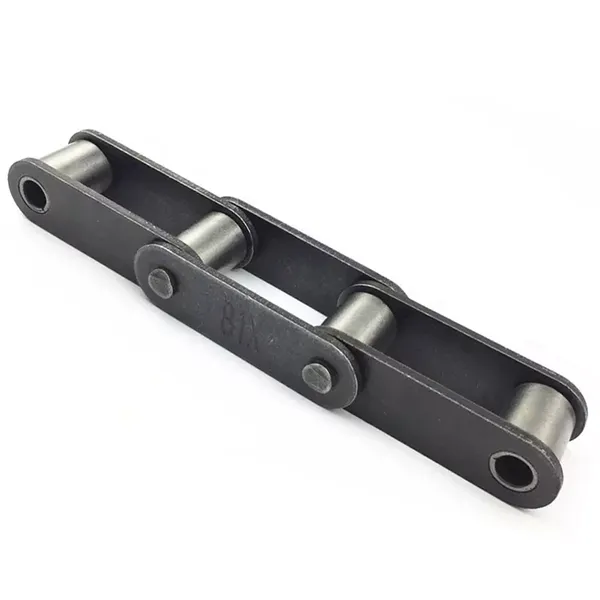
How does a conveyor chain handle inclined or declined conveyance?
A conveyor chain is designed to handle various types of conveyance, including inclined or declined applications. Here’s how a conveyor chain handles these situations:
1. Inclined Conveyance: When a conveyor system is required to move materials uphill, an inclined conveyor chain is used. The chain’s design includes special attachments or cleats that provide additional grip and prevent material from slipping or sliding backward. These attachments are strategically positioned along the chain to ensure effective conveyance on inclines.
2. Declined Conveyance: For conveyors that move materials downhill, a declined conveyor chain is utilized. Similar to inclined conveyance, the chain may have specialized attachments or cleats that help control the speed and prevent material from sliding too quickly. These attachments keep the material in place and ensure a controlled and efficient flow downward.
Both inclined and declined conveyance require careful consideration of the chain’s design, including the type and arrangement of attachments. The size, shape, and weight of the conveyed material also play a role in determining the appropriate chain configuration. It’s important to consult with conveyor chain manufacturers or experts to select the right chain and attachments for specific inclined or declined applications.

Comment une chaîne de convoyage contribue-t-elle à l'efficacité globale de la production ?
Une chaîne de convoyage joue un rôle crucial dans l'amélioration de l'efficacité globale de la production dans diverses industries. Voici comment elle y contribue :
1. Flux continu de matériaux : Une chaîne de convoyage permet un flux de matériaux continu et ininterrompu d’un point à un autre. Elle élimine le besoin de manutention manuelle ou de transport des marchandises, réduisant ainsi les temps d’arrêt et les retards dans les processus de production.
2. Augmentation du débit : L’automatisation de la manutention des matériaux par une chaîne de convoyage permet un déplacement plus rapide et plus efficace des marchandises. Elle permet d’accroître le débit et les cadences de production, optimisant ainsi l’utilisation des ressources et réduisant les temps de cycle.
3. Amélioration de la productivité : Grâce à une chaîne de convoyage, les employés peuvent se concentrer sur des tâches à plus forte valeur ajoutée plutôt que sur la manutention manuelle. Il en résulte une productivité accrue, car les travailleurs peuvent se consacrer à des opérations plus spécialisées et essentielles.
4. Allocation efficace des ressources : Un système de convoyeurs bien conçu optimise l’utilisation de l’espace, permettant une disposition et une organisation efficaces des zones de production. Il contribue à rationaliser le flux de travail et à minimiser le gaspillage de ressources telles que la surface au sol, la main-d’œuvre et l’équipement.
5. Contrôle qualité : Les chaînes de convoyage peuvent être intégrées à des stations d’inspection ou à des processus automatisés afin de garantir le contrôle qualité à différentes étapes de la production. Cela permet de détecter et de corriger tout défaut ou anomalie, réduisant ainsi les risques de mise sur le marché de produits défectueux.
6. Réduction des coûts de manutention : En éliminant ou en minimisant la manutention manuelle, une chaîne de convoyage réduit les coûts de main-d’œuvre liés au transport, au levage et au transport des marchandises. Elle minimise également les risques de blessures ou d’accidents liés à la manutention manuelle.
7. Flexibilité et adaptabilité : Les chaînes de convoyage peuvent être personnalisées pour répondre aux exigences spécifiques de production. Elles peuvent être conçues pour traiter différents types de produits, supporter diverses charges et s’adapter aux variations de la demande. Cette flexibilité permet une intégration fluide aux systèmes de production existants et une mise à l’échelle aisée.
8. Sécurité et ergonomie : Les chaînes de convoyeurs intègrent des dispositifs de sécurité tels que des protections, des boutons d’arrêt d’urgence et des systèmes de verrouillage afin de garantir la sécurité des travailleurs. Elles favorisent également des pratiques ergonomiques en réduisant la fatigue physique et en minimisant les risques de troubles musculo-squelettiques.
Globalement, un système de convoyeurs bien conçu et correctement entretenu améliore l'efficacité de la production en optimisant le flux de matériaux, en augmentant le débit, en améliorant la productivité, en réduisant les coûts, en assurant le contrôle de la qualité et en donnant la priorité à la sécurité des travailleurs.
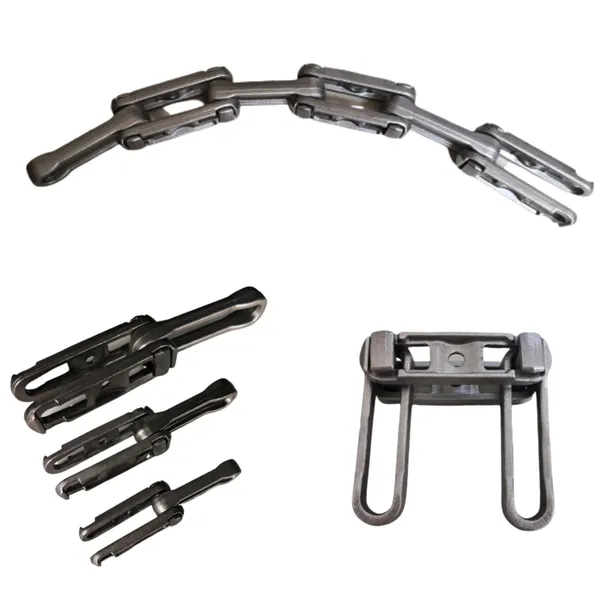
What are the signs of wear and tear in a conveyor chain?
Over time, a conveyor chain may experience wear and tear due to the demanding nature of material handling operations. Several signs indicate the need for maintenance or replacement of a conveyor chain. These signs of wear and tear include:
- Chain Elongation: One of the common signs of wear in a conveyor chain is elongation. As the chain wears, the pitch between the chain links gradually increases, resulting in a longer chain length. Excessive elongation can cause improper engagement with sprockets, leading to slippage or chain derailment.
- Chain Link Plate Wear: The link plates of a conveyor chain can experience wear on their surfaces. This wear is typically caused by friction against sprockets, guide rails, or other components. Signs of plate wear include thinning or deformation of the link plates, which can affect the overall strength and integrity of the chain.
- Sprocket Tooth Wear: The teeth of the sprockets that engage with the conveyor chain can also exhibit signs of wear. Over time, the teeth may become worn down, rounded, or have irregular shapes. This wear can cause improper chain engagement, resulting in reduced efficiency and potential chain slipping or skipping.
- Excessive Noise: Increased noise during the operation of the conveyor system can indicate wear and tear in the chain. Excessive wear can lead to metal-to-metal contact, resulting in noisy operation. Unusual squeaking, grinding, or rattling sounds are indicators that the chain may require inspection or maintenance.
- Visible Damage: Any visible damage to the chain, such as cracked or broken link plates, bent pins, or missing attachments, is a clear sign of wear and tear. These damages compromise the chain’s structural integrity and should be addressed promptly to prevent further issues or chain failure.
- Inconsistent Movement: If the conveyor chain starts to exhibit jerky or uneven movement, it may be a sign of wear or misalignment. Misalignment can occur due to worn chain links, damaged sprockets, or improper tensioning. Inconsistent movement can lead to reduced efficiency, increased wear, and potential chain failure.
Regular inspection and maintenance of the conveyor chain system are essential to identify these signs of wear and tear. Timely replacement of worn components and proper lubrication can help prolong the life of the chain and maintain efficient operation.


editor by CX 2023-10-12