Description du produit
Detailed Photos
Description du produit
Profil de l'entreprise
ZheJiang Miaoou Trading Co., LTD mainly produces and sells bicycle tires and accessories, motorcycle tires, electric car tires, child carriage tires and so on. We always take “create greater benefits for customers” as the purpose, and constantly improve the quality of products. With the continuous development of the enterprise and the increasing expansion of productivity, we hope to cooperate sincerely with friends at home and abroad based on the principle of “good faith and common development
Certifications
Emballage et expédition
Order process
FAQ
Q1. Can I have a sample order for your product?
A: Sample order is welcome here. Mixed samples are acceptable. We can supply the sample if we have ready parts in stock, but the customers have to pay the sample cost and the courier cost.
Q2. Is it OK to print my logo on the product?
A: Yes. Please inform us formally before our production and confirm the design firstly based on our sample.
Q3. Do you have any MOQ limit for the order?
A: Generally, we do not limit MOQ; if you need customized products or mass-produced products, we need to talk in detail.
Q4. How long would it be shipped?
A: Most of our products are in stock;sample or small amount orders :1-3 days , mass production :20-60 days, depending on actual order quantity.
Q5. How do you ship the goods?
A: We usually ship by express way like DHL, UPS, FedEx or TNT. Airline and sea shipping are also optional.
Q6. How long does it take to arrive?
A: Generally, It usually takes 3-7 days to arrive. Except for customized products and order.
Q7: Where is your company located? How can I visit there?
A: Our factory is located in HangZhou Cty, China. You can visit at any time.
/* 22 janvier 2571 19:08:37 */!function(){function s(e,r){var a,o={};try{e&&e.split(“,”).forEach(function(e,t){e&&(a=e.match(/(.*?):(.*)$/))&&1
| Standard ou non standard : | Standard |
|---|---|
| Application: | Textile Machinery, Garment Machinery, Conveyer Equipment, Packaging Machinery, Electric Cars, Motorcycle, Food Machinery, Marine, Mining Equipment, Agricultural Machinery, Car |
| Traitement de surface : | Polissage |
| Exemples : | US$ 1/Piece 1 pièce (commande minimale) | Commander un échantillon Chaîne de transmission |
|---|
| Personnalisation : | Disponible | Demande personnalisée |
|---|
.shipping-cost-tm .tm-status-off{background: none;padding:0;color: #1470cc}
| Frais d'expédition : Frais de transport estimés par unité. | concernant les frais de livraison et le délai de livraison estimé. |
|---|
| Mode de paiement: |
|
|---|---|
| Paiement initial Paiement intégral |
| Devise: | US$ |
|---|
| Retours et remboursements : | Vous pouvez demander un remboursement jusqu'à 30 jours après la réception des produits. |
|---|

Comment calcule-t-on la puissance nécessaire pour un entraînement par chaîne de convoyeur ?
Le calcul de la puissance requise pour l'entraînement d'une chaîne de convoyeur implique la prise en compte de divers facteurs liés au système de convoyage et à l'application spécifique. Voici la démarche à suivre :
1. Déterminer la résistance totale :
– Calculez la résistance totale que la chaîne du convoyeur doit surmonter en fonctionnement. Celle-ci inclut la résistance due à la charge transportée, les pertes par frottement, les variations d'altitude et toute autre résistance du système.
2. Convertir la résistance en inertie équivalente :
– Convertissez la résistance totale en une inertie équivalente en la multipliant par le carré de la vitesse de la chaîne.
3. Calculer l'inertie totale :
– Déterminer l’inertie totale du système en tenant compte de l’inertie de tous les composants rotatifs, tels que la chaîne du convoyeur, les pignons et tout autre élément entraîné.
4. Déterminer le couple requis :
– Calculez le couple requis en multipliant l'inertie totale par le taux d'accélération ou de décélération souhaité.
5. Convertir le couple en puissance :
– Convertissez le couple requis en chevaux-vapeur en le divisant par la vitesse du moteur (en tr/min) et en multipliant par un facteur de conversion.
6. Prendre en compte les facteurs de sécurité et l'efficacité :
– Appliquer des coefficients de sécurité à la puissance calculée pour tenir compte des variations, des imprévus et de la croissance future.
– Tenez compte de l’efficacité du système d’entraînement, notamment du moteur, de la boîte de vitesses et des autres composants de transmission, afin de garantir une transmission de puissance précise.
Il est important de noter que la méthode de calcul ci-dessus fournit une estimation de la puissance requise. Pour des calculs précis et afin de garantir que la transmission par chaîne du convoyeur choisi réponde aux exigences de l'application, il est recommandé de consulter les fabricants de systèmes de convoyage, les ingénieurs ou les normes sectorielles.
How do you prevent corrosion in conveyor chains?
Preventing corrosion in conveyor chains is essential for maintaining their performance and prolonging their lifespan. Here are some effective measures to prevent corrosion:
1. Material Selection: Choose conveyor chains made from corrosion-resistant materials such as stainless steel, plastic, or coatings specifically designed to resist corrosion. These materials offer better protection against rust and corrosion compared to standard steel chains.
2. Proper Lubrication: Apply a suitable lubricant to the conveyor chain regularly. Lubrication creates a protective barrier that helps prevent moisture and contaminants from reaching the metal surface, reducing the risk of corrosion. Select a lubricant that provides corrosion protection properties and is compatible with the chain material.
3. Environmental Controls: Control the operating environment to minimize exposure to corrosive elements. Implement measures such as humidity control, proper ventilation, and protection from direct contact with water or chemicals. Consider using covers or enclosures to shield the conveyor chain from environmental factors that can accelerate corrosion.
4. Surface Treatments: Apply corrosion-resistant coatings or treatments to the conveyor chain. These coatings can provide an additional protective layer that acts as a barrier against moisture and corrosive substances. Examples of surface treatments include zinc plating, galvanizing, or epoxy coatings.
5. Regular Inspections and Cleaning: Regularly inspect the conveyor chain for signs of corrosion or damage. Remove any accumulated dirt, debris, or corrosive substances promptly. Cleaning the chain helps prevent the buildup of contaminants that can accelerate corrosion.
6. Preventive Maintenance: Implement a preventive maintenance program that includes regular cleaning, lubrication, and inspection of the conveyor chain. This proactive approach helps identify and address any potential corrosion issues early on, preventing further damage.
7. Proper Storage: When not in use, store the conveyor chains in a dry and controlled environment. Protect them from exposure to moisture, humidity, and corrosive substances. Use appropriate storage methods, such as hanging the chains or storing them in sealed containers.
By following these preventive measures, you can significantly reduce the risk of corrosion in conveyor chains, ensuring their optimal performance and longevity.

What are the different types of conveyor chains?
There are several types of conveyor chains available, each designed to meet specific application requirements. Here are some common types of conveyor chains:
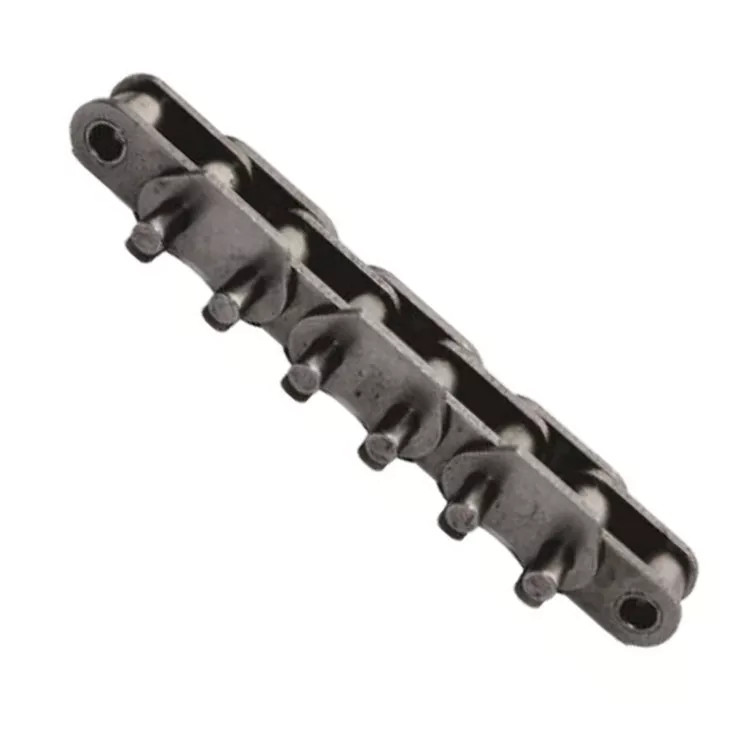
- Roller chains: Roller chains are the most commonly used type of conveyor chain. They consist of a series of cylindrical rollers connected by side plates. Roller chains provide smooth and efficient movement and are suitable for medium to heavy-duty applications.
- Double pitch chains: Double pitch chains have larger pitch (distance between the centers of adjacent pins) compared to standard roller chains. They are often used in applications that require slower speeds and lighter loads.
- Hollow pin chains: Hollow pin chains have hollow pins that allow for easy attachment of various accessories or attachments. They are commonly used in conveying applications that require customization or where attachments need to be mounted.
- Apron or slat chains: Apron or slat chains consist of plates or slats that are connected by hinges. They are used in heavy-duty applications where the chain needs to support and carry large loads or withstand harsh environments.
- Plastic chains: Plastic chains are made of durable and lightweight materials such as acetal or polyethylene. They offer benefits such as corrosion resistance, low noise levels, and the ability to work in wet or washdown environments. Plastic chains are commonly used in food processing, packaging, and pharmaceutical industries.
These are just a few examples of conveyor chain types, and there are many other variations available depending on specific application requirements. The selection of the appropriate conveyor chain type depends on factors such as load capacity, speed, environment, and desired functionality.


editor by CX 2024-04-12