Description du produit
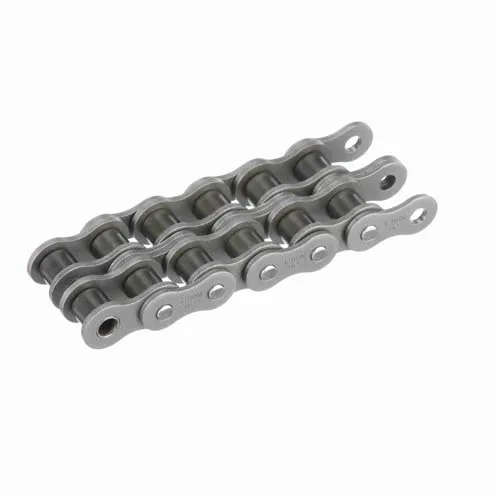
We are Double Pitch Conveyor Chain Manufacturer and always supplying Conveyor chains with competitive price,high quality and regular basis.
These Conveyor chains are used in conveyor applications when loads are low and speeds are moderate. They are similar to the Double-Pitch Power Transmission chains, but with link plates that have an oval contour, and can be produced with either standard or over-sized rollers. They are most often found working on conveyors of all shapes and sizes and can be supplied with 1 or more of our many attachments to carry or convey products.
| ISO Chain No. | ANSI Chain No. | Pas | Roller diameter | Width between innerplates | Pin diameter | Pin length | Inner plate depth | Plate thickness | Ultimate tensile strength | Average tensile strength | |
| p | d1 max | b1 min | d2 max | L max | Lc max | h2 max | T max | Q min | Qo | ||
| m m | m m | m m | m m | m m | m m | m m | m m | kN/bf | kN | ||
| C208A C208AL | C2040 C2042 | 25.40 | 7.95 15.88 | 7.85 | 3.96 | 16.6 | 17.8 | 12.0 | 1.50 | 14.1/3205 | 16.7 |
| C208AH | C2040H | 25.40 | 7.95 | 7.85 | 3.96 | 18.8 | 19.9 | 12.0 | 2.03 | 14.1/3205 | 17.2 |
| C208B C208BL | 25.40 | 8.51 15.88 | 7.75 | 4.45 | 16.7 | 18.2 | 11.8 | 1.60 | 18.0/4091 | 19.4 | |
| C210A C210AL | C2050 C2052 | 31.75 | 10.16 19.05 | 9.40 | 5.08 | 20.7 | 22.2 | 15.0 | 2.03 | 22.2/5045 | 28.1 |
| C212A C212AL | C2060 C2062 | 38.10 | 11.91 22.23 | 12.57 | 5.94 | 25.9 | 27.7 | 18.0 | 2.42 | 31.8/7227 | 36.8 |
| C212AH C212AHL | C2060H C2062H | 38.10 | 11.91 22.23 | 12.57 | 5.94 | 29.2 | 31.6 | 18.0 | 3.25 | 31.8/7227 | 41.6 |
| C216A C216AL | C2080 C2082 | 50.80 | 15.88 28.58 | 15.75 | 7.92 | 32.7 | 36.5 | 24.0| | 3.25 | 56.7/12886 | 65.7 |
| C216AH C216AHL | C2080H C2082H | 50.80 | 15.88 28.58 | 15.75 | 7.92 | 36.2 | 39.4 | 24.0 | 4.00 | 56.7/12886 | 70.0 |
| C220A C220AL | C2100 C2102 | 63.50 | 19.05 39.67 | 18.90 | 9.53 | 40.4 | 44.7 | 30.0 | 4.00 | 88.5/20114 | 102.6 |
| C220AH C220AHL | C2100H C2102H | 63.50 | 19.05 39.67 | 18.90 | 9.53 | 43.6 | 46.9 | 30.0 | 4.80 | 88.5/20114 | 112.4 |
| C224A C224AL | C2120 C2122 | 76.20 | 22.23 44.45 | 25.22 | 11.10 | 50.3 | 54.3 | 35.7 | 4.80 | 127.0/28864 | 147.3 |
| C224AH C224AHL | C2120H C2122H | 76.20 | 22.23 44.45 | 25.22 | 11.10 | 53.5 | 57.5 | 35.7 | 5.60 | 127.0/28864 | 160.9 |
| C232A C232AL | C2160 C2162 | 101.60 | 28.58 57.15 | 31.75 | 14.27 | 64.8 | 69.6 | 47.8 | 6.40 | 226.8/51545 | 278.9 |
| C232AH C232AHL | C2160H C2162H | 101.60 | 28.58 57.15 | 31.75 | 14.27 | 68.2 | 73.0 | 47.8 | 7.20 | 226.8/51545 | 285.8 |
| Matériel: | Alloy Steel/Carbon Steel/ Stainless Steel |
|---|---|
| Structure: | Chaîne à rouleaux |
| Traitement de surface : | Baking Paint , Oxygenation, Electroplating, Polish |
| Taille de la chaîne : | Customized |
| Fonctionnalité: | Fire Resistant, Oil Resistant, Heat Resistant |
| Width Between Inner Plates: | 7.85 – 31.75mm |
| Personnalisation : | Disponible | Demande personnalisée |
|---|

Quels sont les critères à prendre en compte pour choisir une chaîne de convoyeur résistante à la corrosion ?
Lors du choix d'une chaîne de convoyeur résistante à la corrosion, plusieurs facteurs doivent être pris en compte afin de garantir des performances optimales et une longue durée de vie en milieu corrosif. Voici les principaux éléments à considérer :
– Sélection des matériaux :
Choisissez un matériau pour la chaîne de convoyeur résistant aux agents corrosifs spécifiques présents dans l'environnement. L'acier inoxydable, le plastique et les revêtements spéciaux tels que le zingage ou le nickelage sont couramment utilisés pour leurs propriétés de résistance à la corrosion.
– Indices de résistance à la corrosion :
Examinez les indices de résistance à la corrosion des différents matériaux et revêtements de chaînes. Recherchez les normes industrielles telles que les normes ASTM ou ISO qui indiquent la résistance du matériau à des substances corrosives ou à des conditions environnementales spécifiques.
– Facteurs environnementaux :
Tenez compte des facteurs environnementaux spécifiques qui contribuent à la corrosion, tels que l'humidité, la température, la présence de produits chimiques ou de solvants, et l'exposition à l'eau salée ou aux acides. Évaluez comment ces facteurs peuvent affecter les exigences de résistance à la corrosion de la chaîne.
– Revêtement ou traitement de surface :
Si vous utilisez une chaîne métallique, envisagez d'appliquer des revêtements ou des traitements de surface supplémentaires pour améliorer sa résistance à la corrosion. Vous pouvez opter pour la galvanoplastie, le revêtement en poudre ou l'utilisation de revêtements anticorrosion spécifiques.
– Compatibilité avec les méthodes de nettoyage :
Assurez-vous que le matériau de la chaîne choisi est compatible avec les méthodes de nettoyage et les produits chimiques utilisés. Certains matériaux résistants à la corrosion peuvent nécessiter des procédures de nettoyage spécifiques pour préserver leurs performances et leur durée de vie.
– Considérations opérationnelles :
Tenez compte de la capacité de charge, de la vitesse et des exigences opérationnelles du système de convoyage. Assurez-vous que la chaîne résistante à la corrosion puisse supporter les contraintes mécaniques et les exigences opérationnelles sans que ses propriétés de résistance à la corrosion ne soient altérées.
– Rapport coût-efficacité :
Il convient d'évaluer le coût initial et les avantages à long terme de l'utilisation d'une chaîne de convoyeur résistante à la corrosion. Bien que les matériaux résistants à la corrosion puissent présenter un coût initial plus élevé, ils permettent de réduire considérablement les coûts de maintenance, de remplacement et d'arrêt de production liés aux pannes dues à la corrosion.
En tenant compte de ces facteurs, vous pouvez sélectionner une chaîne de convoyeur résistante à la corrosion, parfaitement adaptée à l'environnement corrosif spécifique, garantissant des performances fiables et durables dans des applications telles que le traitement chimique, la production alimentaire, le traitement des eaux usées ou les environnements extérieurs.
Quels sont les avantages de l'utilisation d'un système de chaîne de convoyage modulaire ?
Un système de convoyeur modulaire offre plusieurs avantages en termes de flexibilité, d'efficacité et de facilité d'entretien. Voici quelques-uns de ses principaux atouts :
1. Polyvalence : Les chaînes de convoyage modulaires sont conçues avec des modules emboîtables faciles à connecter et à déconnecter. Cette conception offre une grande flexibilité pour configurer le système de convoyage en fonction des exigences d’agencement, des besoins de production ou des contraintes d’espace. Il est possible d’ajouter, de retirer ou de repositionner des modules pour s’adapter à l’évolution des processus de production ou aux variations de produits.
2. Personnalisation : La conception modulaire du système de convoyeur permet une personnalisation adaptée aux exigences spécifiques de chaque application. Différents types de modules sont disponibles : sections droites, courbes, rampes, descentes, jonctions et déviateurs. Des accessoires tels que des guides latéraux, des taquets ou des dispositifs de maintien de produits peuvent être facilement intégrés au système.
3. Installation et modification rapides : Les chaînes de convoyeurs modulaires sont conçues pour une installation et une modification aisées. Grâce à leurs connexions à enclenchement rapide, les modules peuvent être assemblés ou démontés rapidement, réduisant ainsi les temps d’arrêt lors de la mise en service ou de la reconfiguration du système. Cette caractéristique facilite également la maintenance, les réparations et les extensions futures.
4. Efficacité accrue : La modularité du système de convoyeurs permet une manutention efficace des matériaux et un flux de travail optimisé. Le transfert fluide entre les modules minimise les blocages et les désalignements, garantissant un flux continu et régulier. La possibilité d’intégrer des courbes ou des pentes au système permet une utilisation optimale de l’espace au sol et facilite le déplacement des produits à différentes hauteurs.
5. Maintenance aisée : Les systèmes de convoyeurs modulaires sont conçus pour une maintenance simplifiée. Chaque module est facilement accessible et remplaçable sans démontage complet du système, ce qui réduit les coûts et les délais de maintenance. De plus, la structure ouverte des modules facilite le nettoyage, l’élimination des débris et l’inspection.
6. Durabilité et fiabilité : Les chaînes de convoyeurs modulaires sont généralement fabriquées à partir de matériaux de haute qualité tels que le plastique ou l’acier inoxydable, ce qui garantit leur durabilité et leur longévité. Résistantes à l’usure, à la corrosion et aux produits chimiques, elles conviennent à divers environnements industriels. Leur conception à emboîtement assure la stabilité et empêche le glissement de la chaîne pendant le fonctionnement.
7. Dispositifs de sécurité : Les systèmes de convoyeurs modulaires peuvent intégrer des dispositifs de sécurité tels que des boutons d’arrêt d’urgence, des protections ou des capteurs de blocage ou de surcharge. Ces dispositifs contribuent à garantir un environnement de travail sûr pour les opérateurs et à préserver l’intégrité des produits transportés.
Globalement, un système de convoyeur modulaire offre polyvalence, personnalisation, efficacité et facilité d'entretien. Il constitue une solution fiable pour la manutention de matériaux dans des secteurs tels que la fabrication, l'emballage, la distribution et la logistique.
Quels sont les principaux composants d'une chaîne de convoyeur ?
Les principaux composants d'une chaîne de convoyeur sont les suivants :
- Maillons de la chaîne : Les maillons d'une chaîne sont les éléments constitutifs d'un convoyeur. Généralement métalliques, ils sont assemblés pour former une boucle continue. Leur conception et leur configuration varient selon l'application et les charges requises.
- Épingles : Les goupilles sont des éléments cylindriques qui maintiennent les maillons de la chaîne ensemble. Elles sont insérées à l'extrémité de chaque maillon pour créer une liaison solide. Les goupilles sont généralement en acier trempé afin de résister aux forces et aux frottements au sein du système de convoyage.
- Pignons : Les pignons sont des roues dentées qui s'engrènent avec les maillons de la chaîne et assurent la propulsion du convoyeur. Fabriqués généralement en matériaux résistants comme l'acier ou le plastique, ils sont conçus pour correspondre au pas et au profil de la chaîne. Disponibles en différentes tailles et configurations, ils s'adaptent à la vitesse et à la capacité de charge souhaitées du système de convoyage.
- Rails de guidage : Les rails de guidage sont des éléments fixes installés le long du convoyeur pour guider et soutenir le mouvement de la chaîne. Ils contribuent à maintenir un alignement correct et empêchent la chaîne de dérailler ou de s'écarter de sa trajectoire prévue.
- Tendeurs : Les tendeurs servent à maintenir la tension optimale de la chaîne du convoyeur. Ils garantissent que la chaîne reste tendue et en prise avec les pignons, évitant ainsi tout jeu ou affaissement excessif. Les tendeurs sont réglables pour compenser les variations de longueur de la chaîne et son usure.
- Accessoires et pièces jointes : Selon l'application, les chaînes de convoyeurs peuvent comporter divers accessoires et dispositifs. Il peut s'agir de taquets, de racleurs, de godets ou d'autres éléments facilitant le déplacement et la manutention de matériaux spécifiques. Ces accessoires sont généralement fixés aux maillons de la chaîne à intervalles ou emplacements précis.
L'association de ces composants crée un système de chaîne de convoyage robuste et fiable, capable de transporter efficacement des matériaux dans une large gamme d'applications industrielles.


editor by CX 2023-10-07