Produktbeschreibung
Company Profile
ZheJiang Yupan Machinery Equipment Co., Ltd. is a production of suspension conveyor bearings and conveyor accessories enterprises.
The company is located in Xihu (West Lake) Dis. Town, HangZhou City, ZheJiang Province, our company produces more than 40 sets of CNC lathe equipment, more than 20 sets of CNC grinding machines, and 10 sets of other bearing production equipment.
Main chain bearings, conveyor bearings, logistics bearings, products mainly include: stop bearing, drive chain bearings, suspension chain bearings, traction chain bearings, walking bearings, guide bearings, bearings, rotary roller bearings 7 categories of chain bearings have become the chain bearing accessories industry in the product standard makers
Produktbeschreibung
| outer diameter | specification
| load capacity | |
Φ37travelling wheel | FX150 | 8kg | |
| Φ45guide wheel |
| 8kg | |
| Φ48travelling wheel |
| 20kg | |
| Φ49guide wheel | FX200 | 20kg | |
| Φ57travelling wheel | WF4.11.206 | 30kg | |
| Φ60guide wheel | WF4.11.206 | 30kg | |
| Φ66travelling wheel | FX204 | 50kg | |
| Φ68guide wheel | FX204 | 50kg |
Suspension coVarious styles of suspension chain roller bearings all meet the high temperature and high load environment support customizationnveyor bearing full ball design, high temperature and high load bearing outer ring and inner ring are made of bearing steel hardening hardness HRC58-62 channel precision grinding. The inner ring is 2 pieces together, with Q235 or 20 steel car processing shaft sleeve with the press for riveting to ensure that the whole bearing will not loose. Bearing clearance 0.35-0.55mm. Ensure flexible rotation without jamming during load operation.
Rotary roller bearing outer ring inner ring steel ball made of Gcr15 material outer ring inner ring heat treatment hardening HRC58-62 bearing double row ball design resistant to high temperature and high load suitable for various scenarios
Various styles of suspension chain roller bearings all meet the high temperature and high load environment support customization
The slide frame is used to support the chain, bear the object, and is drawn by the chain along the I-steel dolly, the slide frame without a lifting plate only plays the supporting role is called the no-load slide frame, the slide frame with a lifting plate and can be hung on the pin of the lifting plate is called the load slide frame;
A heavy load slide frame consisting of 2 load slides connected by a heavy load beam;
Considering the spray paint on all sides, it is also designed with a rotating hanger.
Trolley frame manufacturing is divided into precision casting and forging 2 kinds, castings are divided into cast iron and cast steel parts.
The slide frame is equipped with rolling bearings, and the end of the slide frame is also equipped with a pressure injection type oil cup to ensure good lubrication, low running resistance, and its maximum use temperature is 200ºC, such as the use of temperature exceeds, the 2 parties can design and manufacture a special structure of the slide frame, or the use of graphite powder lubrication.
Chain is the traction parts of the conveyor,XT80, XT100, XT160 ordinary hanging conveyor has 2 types of chain, that is, die forging detachable chain pressure detachable chain, the above 2 types of chain in addition to linear movement, can be rotated in the horizontal direction, vertical direction.
product
Anwendungsszenarien
Tire production line
Automobile assembly line
Slaughter line
Car electrophoretic line
Electrostatic spraying line
High speed wire production line
Why Choose Us: The Premier Manufacturer of Suspension Chains and Bearings
Our company, a leading manufacturer of suspension chains and bearings, stands apart with our unparalleled expertise, state-of-the-art facilities, and unwavering commitment to quality. We boast a team of highly skilled engineers and a rigorous testing process to ensure the durability and reliability of our products. Partner with us for superior performance and peace of mind.
/* 22. Januar 2571 19:08:37 */!function(){function s(e,r){var a,o={};try{e&&e.split(“,“).forEach(function(e,t){e&&(a=e.match(/(.*?):(.*)$/))&&1
| Bearing Property: | Full Steel Ball Design |
|---|---|
| Thermostability: | High Temperature Resistance |
| Texture of Material: | Ball Bearing Steels |
| Idler Wheel: | Die Forging Slider Roller |
| Wearproof: | Wearproof |
| Die Forging Chain: | Die Forging Chain |
| Proben: | US$ 50/Piece 1 Stück (Mindestbestellmenge) | |
|---|
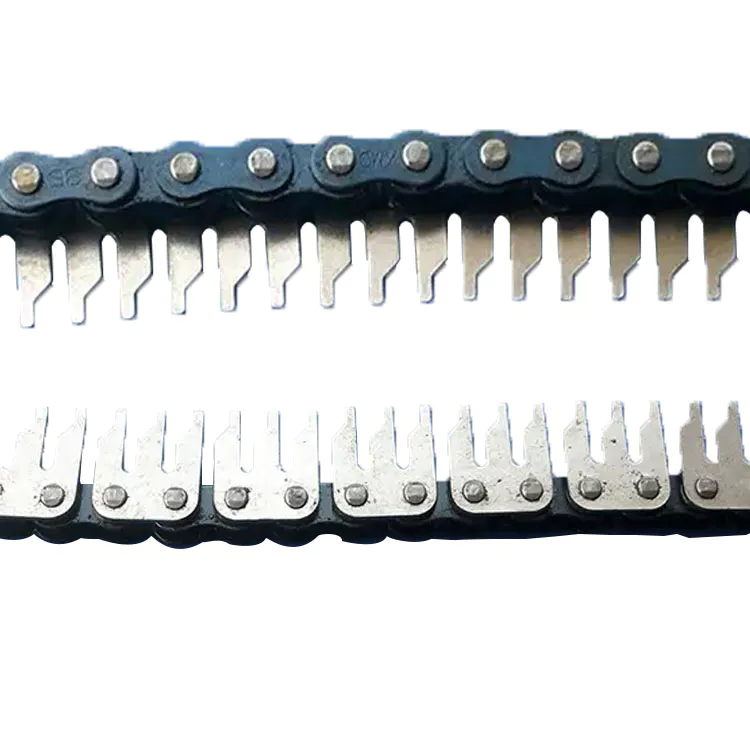
Can a conveyor chain be used in automotive assembly lines?
Yes, a conveyor chain can be effectively used in automotive assembly lines. Here are the reasons why:
1. Efficient Material Handling:
– Conveyor chains provide a reliable and efficient means of transporting automotive components and parts along the assembly line. They can handle heavy loads and withstand the demanding requirements of automotive manufacturing.
2. Versatility:
– Conveyor chains offer versatility in terms of design and configuration. They can be customized to accommodate various assembly processes, such as body welding, painting, assembly, and final inspection.
3. Precise Positioning:
– Conveyor chains allow precise positioning and synchronization of automotive components, ensuring accurate assembly and alignment during the production process. This helps maintain consistent quality and reduces errors.
4. Automation Integration:
– Conveyor chains can be easily integrated with automation systems in automotive assembly lines. They can work in conjunction with robotic arms, vision systems, and other automated equipment to optimize the production process and improve efficiency.
5. Assembly Line Flexibility:
– Conveyor chains provide flexibility in terms of line configuration and layout. They can be designed to accommodate different assembly line layouts, including straight sections, curves, inclines, and declines, to meet the specific requirements of automotive assembly processes.
6. Space Optimization:
– Conveyor chains help optimize space utilization in automotive assembly plants. They can be designed to navigate around existing equipment and infrastructure, making efficient use of available floor space.
7. Safety:
– Conveyor chains are designed with safety features to protect operators and prevent accidents. Emergency stop controls, guarding, and interlocking mechanisms ensure the safe operation of the assembly line.
8. Increased Production Speed:
– By using conveyor chains, automotive assembly lines can achieve higher production speeds, allowing for faster manufacturing cycles and increased output.
Overall, conveyor chains play a crucial role in enhancing the efficiency, productivity, and safety of automotive assembly lines, contributing to the smooth and streamlined production of vehicles.
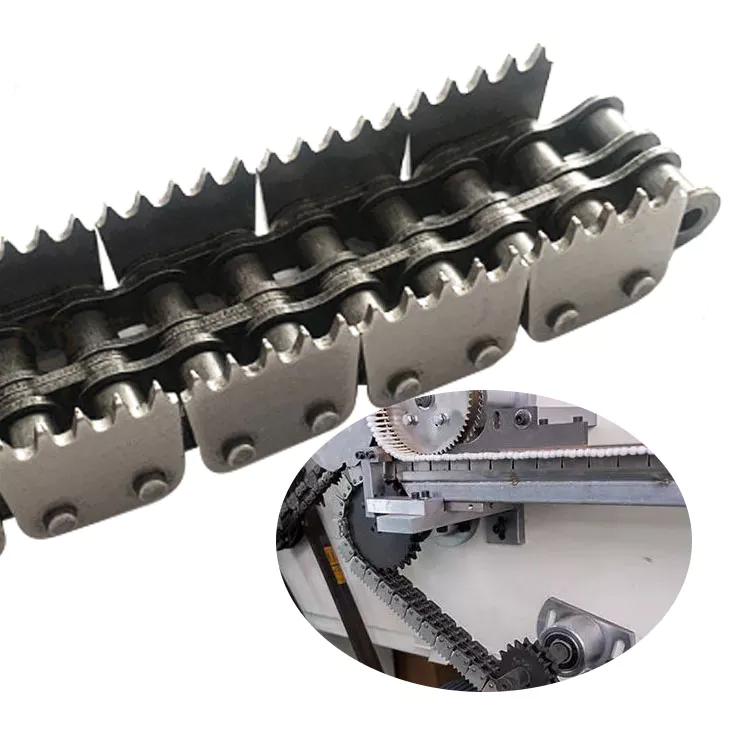
Wie wählt man das geeignete Schmiermittel für eine Förderkette aus?
Die Wahl des richtigen Schmierstoffs ist entscheidend für die Leistungsfähigkeit und Lebensdauer einer Förderkette. Folgende Faktoren sollten Sie bei der Auswahl eines Schmierstoffs berücksichtigen:
1. Kettentyp und -material: Unterschiedliche Förderketten können aufgrund ihrer Konstruktionsmaterialien und ihres Designs spezifische Anforderungen an die Schmierung stellen. Beachten Sie die Empfehlungen oder Spezifikationen des Herstellers, um die Kompatibilität des Schmierstoffs zu ermitteln.
2. Betriebsbedingungen: Berücksichtigen Sie die Betriebsumgebung, wie z. B. Temperatur, Luftfeuchtigkeit und das Vorhandensein von Verunreinigungen. Wählen Sie für Hochtemperaturanwendungen ein Schmiermittel mit höherer Temperaturbeständigkeit. In feuchten oder staubigen Umgebungen sollten Sie Schmiermittel wählen, die eine ausgezeichnete Beständigkeit gegen Auswaschen durch Wasser bieten und wirksamen Schutz vor Verunreinigungen gewährleisten.
3. Belastung und Geschwindigkeit: Beurteilen Sie die Tragfähigkeit und Geschwindigkeit der Förderkette. Höhere Belastungen und Geschwindigkeiten erfordern möglicherweise Schmierstoffe mit besserer Schmierfilmstärke und Verschleißschutzeigenschaften, um die Reibung zu reduzieren und vorzeitigen Verschleiß zu verhindern.
4. Schmierverfahren: Wählen Sie das Schmierverfahren für die Förderkette. Schmierstoffe können mittels Tropfsystemen, Bürsten, Sprühdüsen oder automatischen Schmiersystemen aufgebracht werden. Berücksichtigen Sie Viskosität und Konsistenz des Schmierstoffs, um eine ordnungsgemäße Anwendung und Verteilung zu gewährleisten.
5. Anforderungen an Lebensmitteltauglichkeit: Bei der Lebensmittelverarbeitung oder pharmazeutischen Anwendungen, bei denen ein direkter Kontakt mit dem Produkt möglich ist, ist es unerlässlich, lebensmitteltaugliche Schmierstoffe zu verwenden, die den Branchenvorschriften und Anforderungen an Sicherheit und Hygiene entsprechen.
6. Wartungsplan: Berücksichtigen Sie die gewünschten Wartungsintervalle und die Lebensdauer des Schmierstoffs. Manche Schmierstoffe müssen häufiger nachgeschmiert werden, während andere eine längere Schmierwirkung erzielen.
7. Verträglichkeit mit anderen Materialien: Berücksichtigen Sie die Verträglichkeit des Schmierstoffs mit anderen Materialien im Fördersystem, wie z. B. Dichtungen, Dichtungsringen und Lacken. Stellen Sie sicher, dass der Schmierstoff keine negativen Auswirkungen auf diese Komponenten hat.
Es wird empfohlen, sich mit Schmierstoffherstellern oder Branchenexperten zu beraten, um den am besten geeigneten Schmierstoff für Ihre spezifische Förderkettenanwendung auszuwählen. Diese können Ihnen aufgrund ihrer Expertise und ihres Wissens über Schmierstoffformulierungen und Leistungseigenschaften wertvolle Hinweise geben.
How do you properly tension a conveyor chain?
Properly tensioning a conveyor chain is crucial for its smooth operation and to prevent issues like chain slipping or excessive wear. Here are the steps to properly tension a conveyor chain:
- Identify the Tensioning Points: Determine the locations where the conveyor chain can be tensioned. These are typically at the ends of the chain or at specific tensioning devices.
- Loosen the Tensioning Devices: If there are tensioning devices in place, such as adjustable bolts or tensioning screws, loosen them to allow for adjustment.
- Apply Tension: Apply tension to the conveyor chain by either manually pulling the chain or using a tensioning tool. The amount of tension required depends on the chain type and the manufacturer’s recommendations.
- Check the Tension: Use a tension gauge or other suitable method to measure the tension of the conveyor chain. The tension should fall within the specified range provided by the chain manufacturer.
- Adjust the Tension: If the tension is too loose or too tight, make adjustments accordingly. Tighten or loosen the tensioning devices until the desired tension is achieved.
- Secure the Tensioning Devices: Once the proper tension is achieved, securely tighten the tensioning devices to hold the chain in place.
- Verify the Tension: After tensioning the chain, perform a visual inspection and run the conveyor to ensure the chain runs smoothly without excessive slack or tightness. Make any further adjustments if necessary.
It’s important to refer to the specific guidelines provided by the conveyor chain manufacturer for proper tensioning instructions, as the exact method may vary depending on the chain type and design. Regularly check the tension of the conveyor chain and make adjustments as needed to maintain optimal performance.


editor by CX 2024-04-11